gotcravings
Web app · Personal · 2026
Turned food discovery from endless scrolling into simple, guided choices.
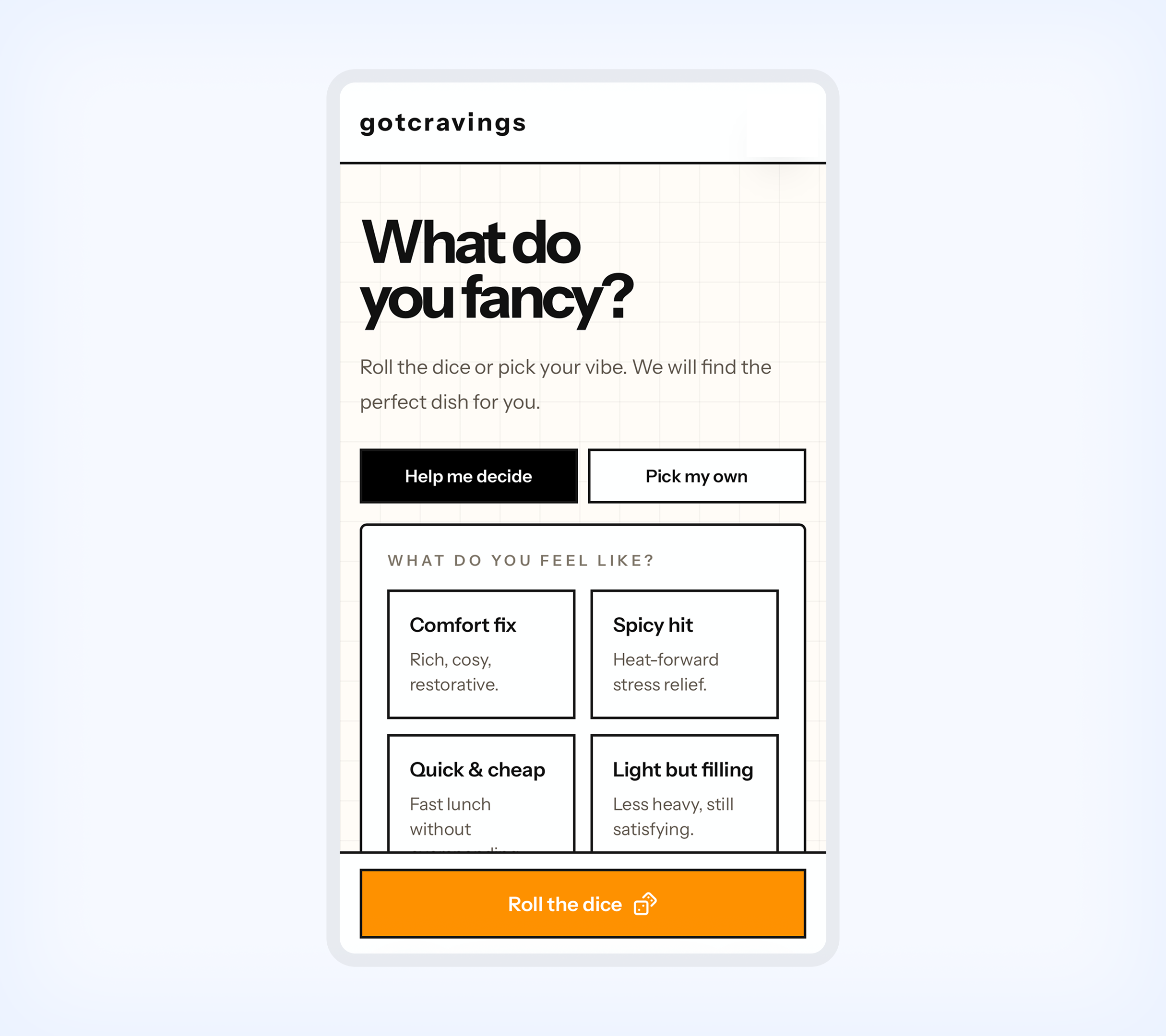
Defined and prototyped a dish-first product thesis that reduces vague intent into a small set of actionable options, optimising for decision quality over exploration.
> Key decisions
01/ Start from dishes, not restaurants
Users think in desired outcomes like ramen or something warming, not in provider lists.
Impact
Decoupled choice from fulfilment and made the system more aligned with how intent actually forms.
02/ Use deterministic logic instead of LLMs
The problem required consistency, speed, and low latency rather than generative flexibility.
Impact
Produced more predictable output quality and avoided unnecessary cost and variance.
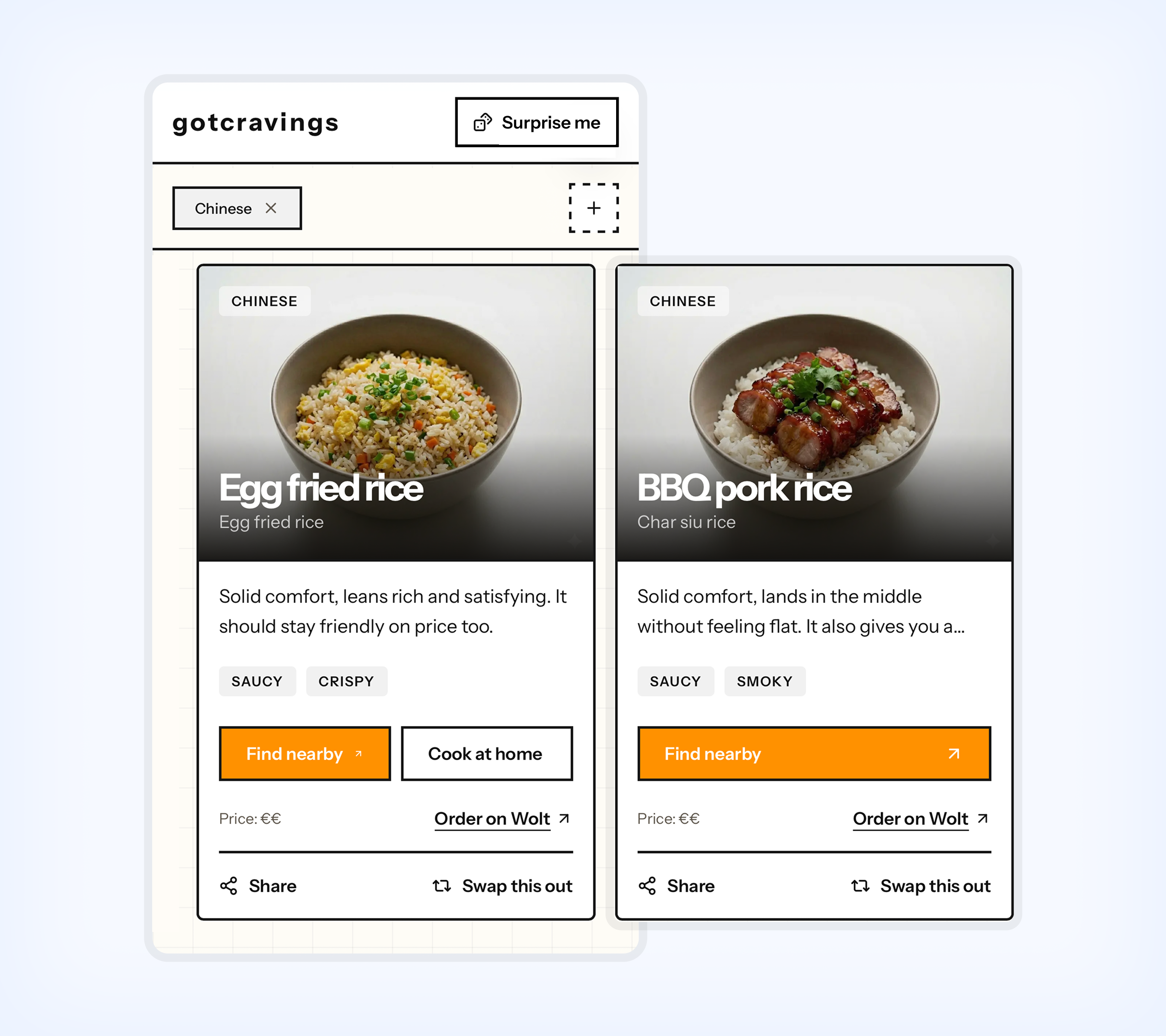
03/ Constrain results to 3–5 options
Decision quality degrades when the system returns too many possibilities.
Impact
Forced the product to take responsibility for ranking rather than outsourcing the decision back to the user.
04/ Replace filters with lightweight intent input
Users struggle to translate fuzzy appetite into structured filters.
Impact
Lowered input friction and kept the flow optimised for speed.
> Trade-offs
01/ Faster decisions vs perceived variety
Constraining options reduces decision time, but it also limits the sense of exploration and breadth.
02/ Reliability vs flexibility
Deterministic logic is faster and more predictable, but it handles edge cases less gracefully than a more adaptive model.
03/ Speed vs user control
Lightweight intent input removes friction, but it gives advanced users less precision than a fuller filtering model.
> Situation
- Product
- > Mobile-first consumer decision-support product for food choice
- Users
- > People who know the kind of meal they want but struggle to turn vague intent into a concrete choice
- Constraints
-
High decision fatigue, low tolerance for friction, and the need for speed and predictability in the recommendation logic
> Problem
Existing food products optimise for volume and exploration. That works for browsing, but it breaks when the real job is to make one confident choice quickly.
> Execution
- > Built a mobile-first interface centred on intent input rather than catalogue browsing.
- > Structured a dish dataset and tagging model to support deterministic ranking.
- > Designed fulfilment paths that could resolve into eating out, delivery, or cooking.
> Results
- > The product framing shifted from restaurant discovery to dish-level decision support.
- > Ranking became the core product responsibility rather than a secondary convenience layer.
- > The concept clarified a sharper validation path around time-to-decision and fulfilment behaviour.